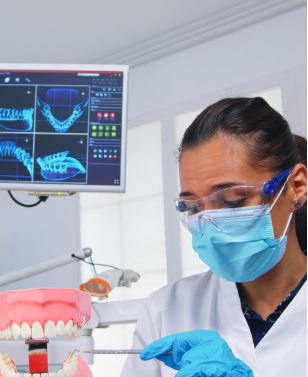
Dental technology has changed significantly over the past several years. Modern dental practices can now use digital imaging, intraoral scanners, advanced diagnostic tools, and computer-assisted systems to examine teeth and plan treatments with greater detail.
For patients, these developments can mean more informed diagnoses, better treatment planning, improved communication, and a more comfortable dental experience.
A modern general dentist does much more than examine teeth and treat cavities. Today’s general dentistry can incorporate technology throughout the patient journey, from the first examination and diagnosis to treatment planning, monitoring, and follow-up care.
This does not mean technology replaces a dentist’s clinical experience. Instead, modern tools can provide additional information that helps dental professionals make informed decisions based on each patient’s individual needs.
Quick Answer: How Does Technology Make General Dentistry More Precise?
Modern dental technology can improve precision by giving a general dentist clearer images, more detailed measurements, and digital information about a patient’s teeth and oral structures.
Tools such as digital X-rays, intraoral scanners, 3D imaging, and digital treatment planning can help dentists identify dental concerns, understand tooth structure, monitor changes, and plan appropriate treatments.
Technology can also improve communication. Patients can often see digital images or scans of their own teeth, making it easier to understand what their dentist is seeing and why a particular treatment may be recommended.
However, technology works alongside professional judgment. A dentist still needs to interpret the information, consider the patient’s symptoms and dental history, and determine the most appropriate treatment.
Key Takeaways
- Modern dental technology provides dentists with more detailed information during examinations.
- Digital X-rays can support the diagnosis of cavities, infections, bone changes, and other dental concerns.
- Intraoral scanners can create detailed digital models of the teeth and oral structures.
- 3D imaging can provide a more comprehensive view when two-dimensional images are not enough.
- Digital records can make it easier to monitor changes in oral health over time.
- Technology can support more accurate treatment planning.
- Digital tools can improve communication between dentists and patients.
- Technology does not replace a dentist’s clinical judgment.
- Regular dental examinations remain important even when you do not have noticeable symptoms.
Why Precision Matters in General Dentistry
Many dental problems can develop before a patient notices obvious symptoms.
A small cavity may not hurt initially. Gum disease can progress without significant discomfort. Changes around the roots of teeth may also be difficult to identify without appropriate diagnostic tools.
Early identification can give a dentist an opportunity to assess the problem before it potentially becomes more complex.
Precision is also important when planning treatment. A dentist needs to understand the condition of the tooth, surrounding structures, and overall oral environment before deciding what approach is appropriate.
Modern technology can provide additional information that supports this process.
Rather than relying on a single visual examination, dentists can combine clinical findings with digital images, scans, patient history, and other diagnostic information.
1. Digital X-Rays Provide Detailed Diagnostic Information
Digital X-rays are one of the most commonly used technologies in modern dental practices.
Traditional visual examinations cannot reveal everything happening beneath the surface of the teeth and gums. X-rays can help dentists examine areas that cannot be seen directly.
Depending on the type of image taken, digital X-rays may help identify:
- Tooth decay between teeth
- Changes around tooth roots
- Bone loss
- Dental infections
- Impacted teeth
- Changes in existing dental work
- Other abnormalities that may require further assessment
Digital imaging also allows dental professionals to view and store images electronically.
When appropriate, a general dentist can compare current images with previous records to monitor changes over time.
How Does This Benefit Patients?
Digital imaging can give your dentist additional information when assessing your oral health.
It can also help patients understand why a particular treatment may be recommended. Seeing an image of a cavity or another dental concern can make an otherwise invisible problem easier to understand.
2. Intraoral Scanners Create Digital Models
Intraoral scanners are another important development in modern dentistry.
Instead of relying exclusively on traditional impressions for certain procedures, an intraoral scanner can capture detailed digital information about the surfaces of the teeth and surrounding oral structures.
A small scanning device is moved around the mouth to collect digital data, which is then used to create a three-dimensional representation.
Depending on the treatment, these digital scans may assist with:
- Restorative treatment planning
- Crowns
- Bridges
- Aligners
- Dental appliances
- Monitoring changes in tooth position
- Patient education
One advantage of digital scanning is that patients may find the process more comfortable than traditional impression materials.
3. 3D Imaging Provides a More Complete View
Two-dimensional X-rays are useful for many routine dental situations, but some cases require additional information.
Three-dimensional dental imaging can provide a more comprehensive view of teeth, jaw structures, and surrounding anatomy.
This type of imaging may be particularly useful when planning more complex dental procedures.
For example, 3D imaging can help dentists evaluate the relationship between anatomical structures and teeth before certain treatments.
It can also provide information that may not be visible from a single two-dimensional image.
However, 3D imaging is not necessary for every patient or every dental appointment. A dentist should recommend advanced imaging when the additional information is clinically appropriate.
4. Digital Technology Supports Better Treatment Planning
Treatment planning is one area where technology can make a significant difference.
A dentist can combine information from clinical examinations, digital X-rays, intraoral scans, photographs, and other appropriate diagnostic tools.
This information can create a more complete picture of a patient’s oral health.
For example, when planning restorative treatment, the dentist may need to consider the existing tooth structure, bite, surrounding teeth, and appearance.
Digital records can help organize this information and support a more detailed treatment plan.
The goal is not simply to use more technology. The goal is to use the right technology when it provides meaningful clinical information.
5. Technology Can Improve Patient Communication
Dental terminology can sometimes be difficult for patients to understand.
A dentist explaining that a tooth has decay, bone loss, or another issue may not immediately make the problem clear.
Digital images and scans can make these conversations easier.
A patient may be able to see an image of the affected area and better understand:
- Where the problem is located
- How extensive it appears
- Why treatment may be recommended
- What the dentist is monitoring
- How the condition changes over time
This visual communication can support shared decision-making.
When patients understand their oral health more clearly, they can have more informed conversations with their dental team.
6. Digital Records Make Monitoring Easier
Dental care is not only about treating problems when they appear. Monitoring changes over time is also important.
Digital records can help a general dentist compare information from different appointments.
For example, a dentist may be able to compare:
- Previous and current X-rays
- Digital scans
- Clinical photographs
- Existing restorations
- Changes in tooth position
- Changes in gum or bone conditions
This can help the dental team identify trends and determine whether a particular area needs closer attention.
Long-term records can therefore become an important part of preventive dental care.
7. Modern Technology Can Support More Conservative Treatment
Accurate diagnosis can sometimes help dentists identify problems earlier.
When a dental concern is identified at an earlier stage, the treatment required may be less extensive than if the problem is allowed to progress.
For example, detecting early tooth decay can allow the dentist to evaluate appropriate preventive or restorative options before significant tooth structure is lost.
The specific treatment always depends on the patient’s circumstances, but better diagnostic information can support more informed decisions.
This is one reason modern technology can contribute to a more preventive approach to general dentistry.
8. Technology Can Improve Comfort and Efficiency
Modern dental technology can also influence the patient experience.
Digital scanning can reduce the need for some traditional impression procedures. Digital records can reduce paperwork and make information easier for dental teams to access.
Advanced imaging systems can also provide diagnostic information without requiring patients to undergo unnecessarily complicated procedures.
While comfort and efficiency vary depending on the treatment, modern technology can contribute to a smoother dental experience.
9. Digital Dentistry Can Support Personalized Care
Every patient’s oral health is different.
A general dentist may see patients with different combinations of dental conditions, previous treatments, oral hygiene habits, and individual goals.
Digital information can help create a more individualized picture of each patient’s mouth.
Instead of relying solely on generalized treatment assumptions, dentists can use available diagnostic information to develop recommendations based on the patient’s specific situation.
This can be particularly useful for patients who require multiple types of dental care.
Is More Technology Always Better?
Not necessarily.
The purpose of dental technology is to improve diagnosis, planning, communication, and patient care. It should not be used simply because a device is available.
Different patients require different diagnostic approaches.
A routine examination may require only a clinical assessment and appropriate X-rays, while a more complex situation may benefit from advanced imaging or digital scanning.
A qualified dentist determines which tools are appropriate based on the patient’s symptoms, dental history, clinical findings, and treatment needs.
Technology is most valuable when it provides useful information that supports better clinical decisions.
Technology Does Not Replace a General Dentist
It is important to understand the role of technology correctly.
A scanner cannot independently determine the best treatment for a patient. An X-ray cannot replace a clinical examination. A digital image still needs to be interpreted by a trained dental professional.
A general dentist brings together multiple types of information, including:
- Medical and dental history
- Patient symptoms
- Clinical examination
- Diagnostic images
- Digital scans
- Previous dental records
- Oral hygiene factors
- Individual treatment goals
The dentist then uses professional knowledge and experience to determine the appropriate next step.
Technology provides information. Clinical judgment turns that information into patient care.
When Should You Visit a General Dentist?
Modern technology is valuable, but it does not eliminate the need for regular dental visits.
You should consider seeing a general dentist if you have:
- Tooth pain or sensitivity
- Bleeding or swollen gums
- Persistent bad breath
- A chipped or cracked tooth
- A loose tooth
- Changes in your bite
- Tooth discoloration
- A dental restoration that feels damaged
- Concerns about your oral health
- A long gap since your last dental examination
Even if your teeth feel healthy, routine dental visits can help identify problems that may not yet cause noticeable symptoms.
Your dentist can recommend an examination schedule based on your individual oral health needs.
Frequently Asked Questions
What technology does a modern general dentist use?
Depending on the practice and treatment, technology may include digital X-rays, intraoral scanners, 3D imaging, digital photography, electronic dental records, and other diagnostic or treatment-planning tools.
Are digital X-rays better than traditional dental X-rays?
Digital X-rays offer advantages such as electronic storage, quick image viewing, and the ability to adjust images for clearer examination. Your dentist determines which type of imaging is appropriate for your situation.
What is an intraoral scanner used for?
An intraoral scanner captures digital information about the teeth and oral structures. Depending on the treatment, the resulting digital model can assist with planning restorations, aligners, dental appliances, and other procedures.
Does every dental patient need 3D imaging?
No. 3D imaging is not necessary for every patient. It may be recommended when a dentist needs more detailed information than a standard examination or two-dimensional X-ray can provide.
Can dental technology detect cavities before they hurt?
Some dental problems can be identified before they cause noticeable symptoms. Clinical examinations and appropriate imaging can help a dentist detect certain forms of tooth decay and other concerns at earlier stages.
Does technology make dental treatment completely pain-free?
Technology can improve comfort and efficiency in certain situations, but no dental technology can guarantee a completely pain-free experience. Your dentist can discuss ways to manage discomfort based on your procedure and individual needs.
How does digital dentistry benefit patients?
Digital dentistry can support detailed diagnosis, treatment planning, record keeping, communication, and monitoring. It may also make certain procedures more comfortable or efficient.
Should I still visit a dentist if I have no symptoms?
Yes. Some dental problems may develop without noticeable pain or other obvious symptoms. Regular dental examinations allow your dentist to assess your oral health and identify concerns that may otherwise go unnoticed.
Final Thoughts
Modern technology is changing general dentistry by giving dental professionals access to more detailed diagnostic information and more efficient ways to plan and monitor treatment. Digital X-rays, intraoral scanners, 3D imaging, and digital records can all support more precise and personalized dental care when used appropriately.
However, technology is only one part of modern dentistry. The experience and clinical judgment of a general dentist remain essential for interpreting diagnostic information and deciding what care is appropriate for each patient.
If you are looking for a dental practice that combines personalized care with modern technology, Dandon Dental provides comprehensive dental services in North York and uses digital tools to support diagnosis, treatment planning, and patient care. Book an appointment to discuss your oral health needs and learn how modern general dentistry can support your smile.